
Mark Sutcliffe Still Leads Mayoral Race, But That Lead Has Shrunk
Ottawa’s next municipal election is October 26th, 2026. In June, when we first asked Ottawans how they would vote, that felt like ages away. Quorus’ latest survey shows that over the past four months, Ottawans have clearly become engaged in this Mayoral election.
Quorus Consulting conducted a survey of 807 Ottawa residents from October 8 to 15. This release also compares results to what we found when we surveyed 403 Ottawa residents from June 16 to 23.
The Mayoral Horse Race Numbers
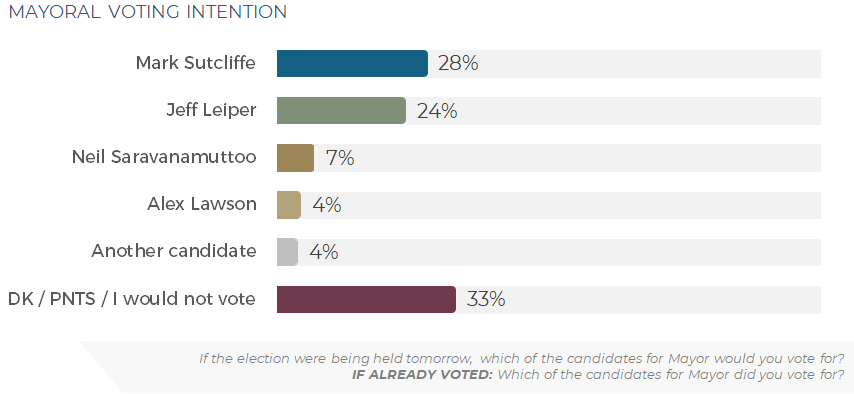
In terms of the vote intention horse race, most respondents now identify a preferred candidate. Among all Ottawa respondents, when provided with the full list of 14 candidates for Mayor that are on the ballot, 28% indicate they have already or would vote for Mayor Mark Sutcliffe; 24% Jeff Leiper; 7% Neil Saravanamuttoo; 4% Alex Lawson; 4% opt for one of the ten other candidates; and 33% either would not vote, don’t know, or prefer not to say.
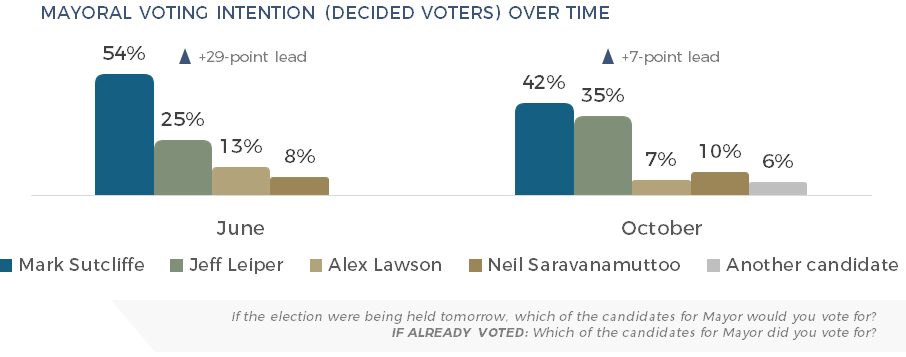
Removing the 33% who do not offer a choice on the ballot, if the election were held now, Mayor Mark Sutcliffe would be re-elected with 42% of the vote, with Jeff Leiper (35%) coming in second, Neil Saravanamuttoo 10%, Alex Lawson 7% and 6% distributed among the remaining candidates.
That represents a 7% lead for Mark Sutcliffe, which is comfortable enough to suggest victory, but represents a remarkable reduction in a 29% lead we measured in June.
Turnout Matters and Historic Trends
In terms of the vote intention horse race, most respondents now identify a preferred candidate. Among all Ottawa respondents,, 28% indicate they have already or would vote for Mayor Mark Sutcliffe; 24% Jeff Leiper; 7% Neil Saravanamuttoo; 4% Alex Lawson; 4% opt for one of the ten other candidates; and 33% either would not vote, don’t know, or prefer not to say.
Removing the 33% who do not offer a choice on the ballot, if the election were held now, Mayor Mark Sutcliffe would be re-elected with 42% of the vote, with Jeff Leiper (35%) coming in second, Neil Saravanamuttoo 10%, Alex Lawson 7% and 6% distributed among the remaining candidates.
That represents a 7% lead for Mark Sutcliffe, which is comfortable enough to suggest victory, but represents a remarkable reduction ins a 29% lead we measured in June.
Sutcliffe enjoys a healthy lead among those aged 55 and older, as well as among homeowners – two segments that have a higher tendency to vote in municipal elections.
Filtering the results to only those who either say they have already voted (10%) or claim they definitely will (59%), then the race appears even tighter and Leiper actually has a technical lead. However, there are reasons to be skeptical of that outcome. For one thing, turnout for municipal elections is rarely (if ever) as high as the 69% this implies. In addition, since Leiper leads among those under 55 and those who rent — and both of these segments are historically less inclined to turnout — that makes the Leiper lead among this group of self-described certain voters seem to be an unreliable measure.
Click HERE to download a PDF version of this report.
Click HERE to download data table 1 for this report.
Click HERE to download data table 2 for this report.
Click HERE to download data table 3 for this report.
Click HERE to download data table 4 for this report.
Click HERE to download data table 5 for this report.
Click HERE to download data table 6 for this report.
What is the Quorus metroVox?
Every quarter, Quorus conducts an online survey of n=500 residents of the NCR (400 in Ottawa and 100 in Gatineau), with sampling carefully controlled to be reflective of residents 18 years of age and older. To cover the Ottawa mayoral race, this special edition of the metroVox was held with over n=900 residents of the NCR (807 in Ottawa and 151 in Gatineau).
The survey results presented in this document were derived from a study designed, executed and sponsored by Quorus Consulting. They represent the opinions of 807 randomly selected members of Leger’s opt-in panel, Ottawa residents, 18 years of age and older, who completed an online survey between October 8-15, 2026.
The data are weighted to replicate actual population distributions by age and gender within region, according to the most recent Census data available. A margin of error could not be calculated due to the use of a non-probability sample, i.e. respondents were selected only from among those who had registered to participate in online surveys through a panel. Respondents had the option to complete the survey in either English or French.
To inquire about our research findings or media availability, contact This email address is being protected from spambots. You need JavaScript enabled to view it. (613-293-2312)
 Accredited Member of CRIC